Headline Formulas: How to Write SEO Titles That Get Clicks (2026)
Twelve proven headline formulas with examples, how long an SEO title should be, how to use power words without clickbait, and how to test titles with Search Console.
In this article
- Key takeaways
- Post title vs SEO title: which one are you writing?
- 12 headline formulas that get clicks
- 1. How to [result]
- 2. How to [result] without [pain]
- 3. [Number] [ways/tips/ideas] to [result]
- 4. [Number] [mistakes] that [bad outcome]
- 5. What is [term]? [Plain-English promise]
- 6. Why [surprising fact or problem]
- 7. [Topic]: The Complete Guide ([Year])
- 8. [A] vs [B]: [Which one wins for whom]
- 9. Best [product] for [audience or need]
- 10. [Result] in [time or steps]
- 11. [Template / checklist / examples] for [task]
- 12. [Do this], not [that]
- How long should an SEO title be?
- Power words and emotional words: use a little, not a lot
- Write the headline in five steps
- Score your headline with RankFlect SEO's free headline analyzer
- Test your titles with real search data
- Frequently asked questions
- What is the best headline formula for SEO?
- How many characters should an SEO title have?
- Should the H1 and the SEO title be the same?
- Do numbers in titles really help?
- Do power words help rankings?
Headline formulas are proven patterns, like "How to X without Y" or "7 ways to X", that you fill in with your own topic to write titles people want to click. The best SEO titles use a formula as a starting point, put the main keyword near the front, make a specific promise the page keeps, and fit in the space Google shows. This guide gives you 12 headline formulas with examples, the rules for length and word choice, and a simple way to test what works.
It is about writing the words. If you want to know where to set SEO titles in WordPress, see our guide to the plugin settings instead.
Key takeaways
- A good title is specific, honest and front-loaded: the most important words come first.
- Formulas (how-to, list, question, comparison) work because they tell the reader exactly what they get.
- Google has no character limit for titles but cuts long ones to fit the screen, about 580 pixels on desktop.
- One or two strong words help. A title stuffed with "ultimate", "amazing" and "secret" reads like spam.
- Test titles with Search Console data, not guesses, and give each change a few weeks.
Post title vs SEO title: which one are you writing?
WordPress pages have two titles that are easy to mix up:
- The post title is the headline at the top of the page, usually the H1. Readers see it after they click.
- The SEO title is the
<title>tag. Google usually uses it as the blue link in search results, and browsers show it in the tab.
They can be the same, and on most blogs they are close. Many sites keep the post title a little longer and more conversational, and use a tighter SEO title with the site name at the end. Everything below applies to both, but the length rules matter most for the SEO title, because that is what gets cut in search results.
Google's guide to title links also says Google may write its own title link when yours is vague, stuffed with keywords or doesn't match the page. It can draw on your H1, other headings and anchor text. That's one more reason to keep the post title and SEO title consistent.
12 headline formulas that get clicks
Each formula below has a pattern and two examples. Swap in your own topic and keyword.
1. How to [result]
The classic. It matches how people search and promises a clear outcome.
- How to Repot a Snake Plant Without Killing It
- How to Set Up a WooCommerce Store in One Afternoon
2. How to [result] without [pain]
Adds the objection the reader already has. Use it when there is a known downside to remove.
- How to Learn Spanish Without Boring Grammar Drills
- How to Move WordPress Hosts Without Downtime
3. [Number] [ways/tips/ideas] to [result]
Numbers set expectations and make a title easy to scan. Use the real count of items in the post.
- 9 Ways to Keep Pickles Crunchy
- 15 Low-Light Houseplants That Are Hard to Kill
4. [Number] [mistakes] that [bad outcome]
Fear of getting it wrong is a strong pull, as long as the post fixes each mistake.
- 7 Sourdough Mistakes That Make Your Bread Flat
- 5 Redirect Mistakes That Lose Rankings
5. What is [term]? [Plain-English promise]
For definition searches. The second half tells the reader they won't get jargon.
- What Is Schema Markup? A Plain-English Guide
- What Is a Roth IRA? How It Works, in 5 Minutes
6. Why [surprising fact or problem]
Questions that start with "why" promise an explanation. They work well for troubleshooting.
- Why Your Tomato Leaves Are Turning Yellow (and How to Fix It)
- Why Google Isn't Indexing Your New Pages
7. [Topic]: The Complete Guide ([Year])
For long, thorough pages. The year signals freshness, but only use it if you keep the page updated.
- Composting at Home: The Complete Guide (2026)
- Email Marketing for Small Shops: A Complete Guide
8. [A] vs [B]: [Which one wins for whom]
Comparison searches have strong intent. Say who each option suits instead of declaring a winner for everyone.
- Air Fryer vs Convection Oven: Which Is Better for Small Kitchens?
- Shopify vs WooCommerce: Which Fits a One-Person Store?
9. Best [product] for [audience or need]
The audience part is what makes it specific and believable.
- Best Running Shoes for Flat Feet
- Best Budget Microphones for Podcast Beginners
10. [Result] in [time or steps]
Promises speed or simplicity. Only use a time you can honestly deliver.
- Make Mango Pickle in 3 Days
- Fix a Leaky Tap in 4 Steps
11. [Template / checklist / examples] for [task]
People search for things they can copy. Name the asset in the title.
- Free Wedding Budget Template (Google Sheets)
- 27 Product Description Examples for Online Shops
12. [Do this], not [that]
A contrast that challenges a common habit. Good for opinion and strategy posts.
- Water Deeply, Not Daily: A Better Way to Water Your Lawn
- Write for Readers, Not Word Counts
How long should an SEO title be?
Google does not set a character limit. Its documentation says there is no limit on how long a <title> element can be, but title links are truncated to fit the device width. In practice that means width in pixels, not characters: a title full of wide letters like "W" and "M" gets cut sooner than one with narrow letters like "i" and "l".
A safe working range:
- Aim for about 50–60 characters for the SEO title, including your site name.
- Keep it under roughly 580 pixels, the width Google shows on desktop. A pixel-based length bar is more reliable than a character count.
- Front-load the keyword and the promise. If the end gets cut, readers still see what matters.
- Keep the brand short and put it at the start or end, after a separator such as a dash or a pipe. Google's guide suggests this for inner pages, and most blogs put it at the end.
Post titles (the H1) can run a little longer, because they are not cut in search results. Keep them readable: about 6 to 12 words is a comfortable range for most headlines.
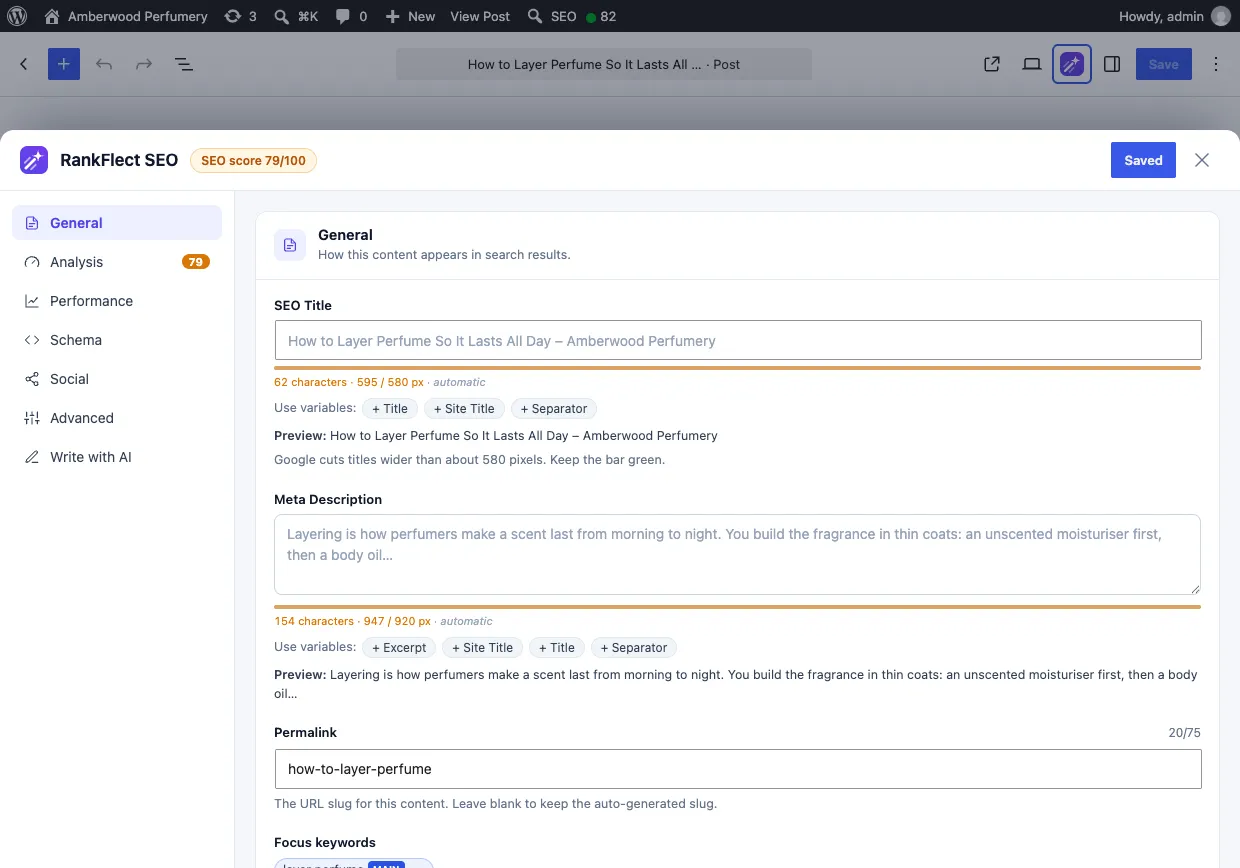
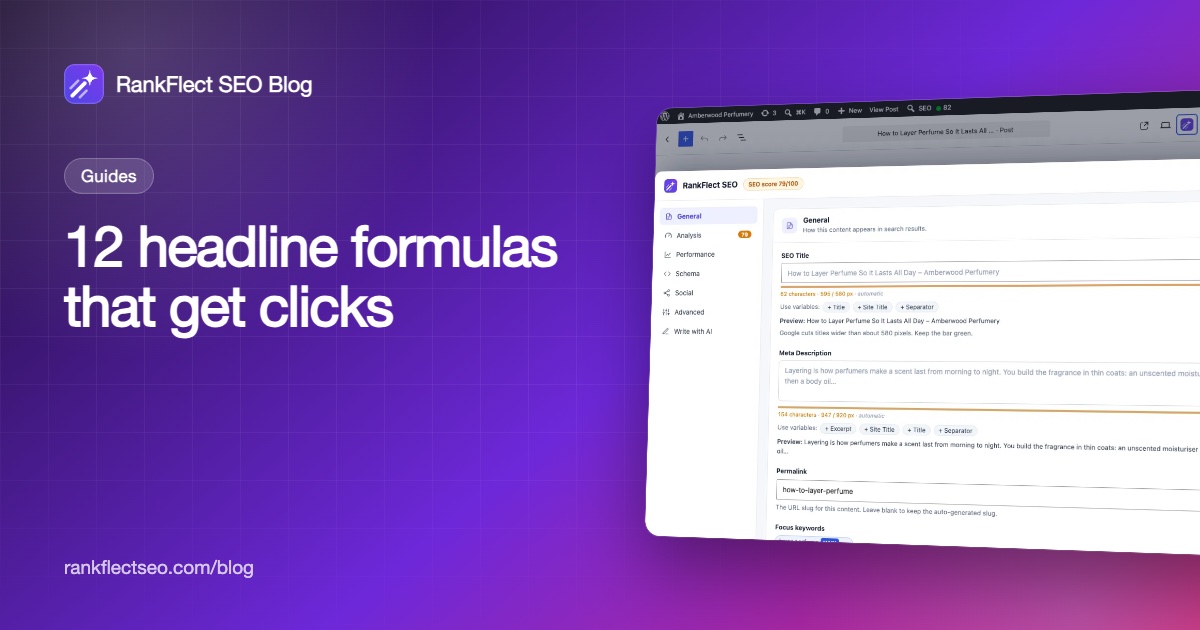
In RankFlect SEO, the SEO Title field shows a length bar measured in pixels, the way Google cuts titles, plus a preview. In the example above, "How to Layer Perfume So It Lasts All Day – Amberwood Perfumery" is 62 characters and 595 pixels, just over the limit, so the end of the site name would be cut. Shortening the site name or dropping it on this one post would fix it. See Edit SEO in the block editor and Set up titles and meta descriptions.
Power words and emotional words: use a little, not a lot
Headline writers group words into a few types:
- Common words like "how", "you", "your" and "the" make a title read naturally.
- Uncommon words like "mistakes", "guide" or "checklist" make it specific.
- Emotional words like "love", "fear" or "surprising" create a feeling.
- Power words like "proven", "free", "step-by-step" or "complete" signal value.
One or two emotional or power words can lift a dull title. More than that starts to look like clickbait, and Google's title guidance warns against stuffing titles with repeated terms. Compare:
- Weak: "Houseplant Care"
- Better: "Houseplant Care for Beginners: 10 Simple Rules"
- Overdone: "The Ultimate, Shocking, Proven Secrets of Amazing Houseplant Care"
Sentiment matters too. A clearly positive ("simple", "easy", "faster") or clearly negative ("mistakes", "stop", "avoid") title usually stands out more than a flat, neutral one. Pick the one that fits the post.
Write the headline in five steps
- Start from the search. Google's SEO starter guide asks for titles that are unique, clear, concise and accurate to the page. Write down the focus keyword and what the searcher wants: to learn, compare, buy or fix something.
- Pick a formula that matches that intent. How-to for tasks, lists for ideas, "vs" for comparisons, "what is" for definitions, "best" for buying.
- Write five versions. Swap the formula, the number, the benefit and the audience. The first draft is rarely the best.
- Cut and front-load. Move the keyword and the promise to the front, then remove filler like "In this article" or "Everything you need to know about".
- Check it against the page. If the title promises 10 tips, the post needs 10. A title that over-promises loses readers in seconds, and Google may replace a title that doesn't match the page.
Score your headline with RankFlect SEO's free headline analyzer
RankFlect SEO includes a free headline analyzer that scores your post title from 0 to 100 as you type. In the block editor, open the RankFlect SEO panel and choose Analysis; the Headline Analyzer card sits under the SEO score. In the Classic Editor and Elementor, it is the collapsible Headline (post title) panel.
For English content, it scores:
- Characters: full points for 40 to 60.
- Words: full points for 6 to 12.
- Word balance: the share of common, uncommon, emotional and power words, with one or two power words being enough.
- Type: list, how-to and question headlines score highest, a headline with a number scores slightly less, and a plain statement less again.
- Sentiment: clearly positive or negative scores higher than neutral.
- Fits in Google: whether the title fits in about 580 pixels on desktop, with a preview of where it gets cut.
Each part shows its points and a tip, worst first, so you know what to change. The score is worked out in your browser, and nothing is sent anywhere. For other languages, it scores characters, words, type and the Google cut-off only.
If you add your own AI provider key, Suggest better titles writes a few alternatives from the saved post, each with its own headline score. Click one to use it.
Two things to keep in mind. The headline score is separate from the SEO score from the content analysis checks, and it checks the post title, not the SEO title. And don't chase 100: a clear, honest title that matches the post beats a perfect score.
Test your titles with real search data
The only score that really counts is click-through rate (CTR) in search. To test a title:
- In Google Search Console, open Performance, filter by the page, and note its clicks, impressions, CTR and average position for the last 28 days.
- Change the SEO title, and keep everything else the same.
- Wait until Google has recrawled the page. Google says title changes can take a few days to a few weeks to show.
- Compare the next 28 days with the previous 28. A higher CTR at a similar position means the new title works better.
Position changes affect CTR on their own, so compare pages at similar positions, and don't judge a title on a handful of clicks. Our guide to Google Search Console for WordPress shows how to connect and read the data. A matching meta description helps too: see how to add a meta description in WordPress.
In RankFlect SEO Pro, the Search Console opportunities tab does the first step for you. Its "Titles that underperform for their ranking" list shows page-one pages with less than half the CTR that is typical for their position, with a Rewrite title button that uses your AI provider. The change is recorded in the Change Log, so you can undo it.
If you want to try the headline analyzer on your own posts, download RankFlect SEO free. It works on any number of sites.
Frequently asked questions
What is the best headline formula for SEO?
There isn't one best formula. Match the formula to the search intent: "How to" for tasks, numbered lists for ideas and tips, "X vs Y" for comparisons, "What is" for definitions and "Best X for Y" for buying decisions. The right formula is the one that tells the searcher you have exactly what they want.
How many characters should an SEO title have?
Aim for about 50 to 60 characters. Google has no fixed character limit, but it cuts titles to fit the screen, about 580 pixels on desktop. Put the keyword and the main promise first, so a cut doesn't hide them.
Should the H1 and the SEO title be the same?
They don't have to be, but they should say the same thing. Google may build a title link from your H1 and other text if your SEO title doesn't match the page. Many sites use a slightly longer H1 and a tighter SEO title with the brand at the end.
Do numbers in titles really help?
Numbers make a promise specific and easy to scan, which is why list headlines are so common. Use the real number of items in the post. A number only helps if the content delivers what it says.
Do power words help rankings?
No. Power words can make a title more appealing to click, but they are not a ranking factor. Use one or two where they fit, and never at the cost of clarity.
- #headline formulas
- #seo titles
- #headline analyzer
- #click-through rate
- #copywriting
Written by
RankFlect SEO TeamThe people who build RankFlect SEO, the WordPress SEO plugin with a built-in MCP server. We write about what we learn shipping SEO tools for AI search.
All articles →Let AI agents fix your SEO. You keep the undo button.
RankFlect SEO is free for unlimited sites, with a built-in MCP server, approval for every change and no AI credits.