GEO vs SEO in 2026: What Changed and What to Do on WordPress
Generative engine optimization and SEO overlap more than the hype suggests. Here is what is different, what is not, and what to do first on WordPress.
In this article
- Key takeaways
- What GEO and AEO actually mean
- GEO vs SEO: what really differs
- 1. The result is a citation, not a position
- 2. More crawlers, with different jobs
- 3. Mentions elsewhere count for more
- 4. Answers vary from run to run
- 5. Fewer clicks per appearance
- 6. Measurement is less mature
- What stays the same
- What changed in 2026
- A prioritized GEO action list for WordPress
- What to skip
- How to measure GEO alongside SEO
- How RankFlect SEO covers both
- Frequently asked questions
- Is GEO replacing SEO?
- What is the difference between GEO and AEO?
- Does GEO hurt my Google rankings?
- Do I need llms.txt for GEO?
- How long does GEO take to show results?
GEO vs SEO is less of a fight than the headlines suggest. SEO earns you a ranked link in search results; generative engine optimization (GEO) earns you a mention or citation inside an AI answer, and most of the work that gets you one also gets you the other. What did change in 2026 is scale, measurement and a few new technical settings, so this guide covers what is different, what is the same and what to do first on a WordPress site.
Key takeaways
- GEO means making your content easy for AI answer engines to find, understand and cite. AEO (answer engine optimization) is a close cousin and is often used for the same thing.
- The foundation is shared: crawlable, indexed, clearly written, well-structured pages from a brand others trust.
- What differs is the output (a citation, not a position), the crawlers you must allow, the role of third-party mentions and how you measure results.
- On WordPress, start with crawler access and indexing, then content structure and brand identity, then measurement. Skip anything sold as a shortcut.
What GEO and AEO actually mean
The term "generative engine optimization" comes from a research paper, GEO: Generative Engine Optimization, first posted in November 2023 and accepted to KDD 2024. The authors built a benchmark of queries and tested ways to make a source more visible in AI-generated answers. In their tests, some methods improved visibility by up to 40%, and results varied by domain. That is a lab result on their benchmark, not a promise for your site.
Since then, the label has spread to cover any work aimed at AI answers:
- GEO: getting cited or mentioned by generative engines such as ChatGPT, Gemini, Claude, Perplexity, Copilot and Google's AI Overviews and AI Mode.
- AEO: answer engine optimization. The term is older and was first used for featured snippets and voice assistants. Today it is mostly a synonym for GEO.
- LLMO or AI SEO: other names for the same idea.
Don't get stuck on the acronym. The question that matters is whether an assistant can reach your page, understand it and trust it enough to quote it.
GEO vs SEO: what really differs
Classic SEO and GEO overlap heavily, but six differences are real and worth planning for.
1. The result is a citation, not a position
In classic search, you rank somewhere on a results page. In an AI answer, you are either named, linked as a source, both or neither. There is no position 7 to climb from. An assistant also blends several sources into one answer, so the page that gets cited is often the one with the clearest, most specific passage on that sub-question.
2. More crawlers, with different jobs
Google uses Googlebot for both Search and its AI features. Other AI companies run separate bots for training, for their search index and for live fetches when a user asks something. OpenAI's crawler documentation, for example, says sites that opt out of OAI-SearchBot won't be shown in ChatGPT search answers, while GPTBot is only for model training. Your robots.txt now needs a decision per bot, not just one rule for everyone.
3. Mentions elsewhere count for more
AI answers often cite review sites, directories, forums, Wikipedia and comparison articles. If those sources mention your brand, you can appear in an answer even when your own page isn't the cited source. Classic SEO valued links; GEO also values plain brand mentions in the places assistants read.
4. Answers vary from run to run
Ask the same question twice and an assistant may name different brands. That makes single checks misleading. You need repeated checks over weeks and should look at trends, not one screenshot.
5. Fewer clicks per appearance
An answer that summarizes your page may satisfy the reader without a visit. Pew Research Center found in July 2025 that users clicked a traditional result on 8% of visits to Google results pages with an AI summary, compared with 15% without one. Visibility and traffic are no longer the same metric.
6. Measurement is less mature
Search Console has years of history for classic search. For AI answers you combine several partial signals: crawler logs, referral sessions in analytics, AI feature impressions in Search Console and repeated prompt checks.
What stays the same
The overlap is bigger than the difference. Google says in its AI features guidance that there are no additional requirements or special optimizations needed to appear in AI Overviews or AI Mode. Other assistants also run web searches and read the pages they find. So the classic basics still decide whether you are even in the pool:
- Pages must be crawlable, indexed and free of accidental
noindexornosnippettags. - Content must be helpful, specific and written for people.
- Headings, short paragraphs, lists and FAQ sections make pages easy to read and quote.
- Structured data and consistent brand details help machines identify who you are.
- Fast, mobile-friendly pages with good internal links still win.
If your SEO is weak, GEO won't rescue it. If your SEO is strong, you are most of the way there.
What changed in 2026
The difference between 2024 and 2026 is mainly scale and tooling. A few dated, sourced data points:
- Google said in its Q2 2026 earnings remarks (July 2026) that AI Mode had passed 1 billion monthly active users.
- OpenAI announced 900 million weekly ChatGPT users in February 2026, as reported by TechCrunch.
- Google launched Search Generative AI performance reports in Search Console in June 2026, showing impressions in AI features. Google says they reached all websites by August 31, 2026.
In short, AI answers are now a mainstream way people find information, and Google has started giving site owners first-party data on them.
A prioritized GEO action list for WordPress
Do these in order. The first steps unblock everything else; the later ones improve your odds.
- Allow the AI search and user bots. Keep OAI-SearchBot, ChatGPT-User, Claude-SearchBot, Claude-User, PerplexityBot and Perplexity-User allowed in robots.txt. Decide on training bots (GPTBot, ClaudeBot, Google-Extended) separately; blocking them doesn't remove you from AI search. Also check your CDN or firewall isn't challenging these bots.
- Get indexed in Google and Bing. Submit your XML sitemap in both Search Console and Bing Webmaster Tools. Bing's index powers Microsoft Copilot, and IndexNow helps Bing hear about updates quickly.
- Fix your most important pages first. Pick the 10 to 20 pages that answer the questions your customers ask. Rewrite each to open with a direct answer, then the detail.
- Add structure. One heading per sub-question, short paragraphs, lists for steps, and an FAQ section with the follow-up questions people really ask.
- Be specific and cite sources. Prices, dates, measurements, names and your own first-hand experience give an assistant something worth quoting. Link to primary sources for any claim.
- Make your brand identifiable. Use Organization or Person schema with a logo and
sameAslinks to your real profiles, and keep your name and details the same everywhere. - Earn mentions where AI looks. Find which sites assistants cite for your topic and work on being listed, reviewed or quoted there.
- Publish llms.txt as a convenience. It helps some AI tools and agents navigate your site. It is not a Google ranking factor. Our llms.txt guide for WordPress explains what it does and doesn't do.
- Measure monthly. Track crawler visits, AI referral sessions, Search Console AI impressions and a fixed set of test prompts.
For tactics specific to ChatGPT, read how to get cited by ChatGPT and other AI search tools.
What to skip
Because GEO is new, it attracts shortcuts. These waste time or carry risk:
- Hidden text or prompts aimed at AI. Text shown only to bots is cloaking under Google's spam policies and can hurt classic rankings.
- Keyword-stuffed "AI-friendly" rewrites. Assistants quote clear passages, not repeated phrases.
- Fake reviews or self-written "best of" lists that rank yourself first. They erode trust with readers and with the sites assistants rely on.
- Tools that promise guaranteed AI citations. No one controls what a model says.
How to measure GEO alongside SEO
Keep your normal SEO reporting and add four AI signals:
- AI crawler visits: which bots read which pages, and whether user-triggered fetches grow after you publish.
- AI referral sessions in Google Analytics 4: visits from chatgpt.com, perplexity.ai, claude.ai, gemini.google.com and similar sources.
- AI feature impressions in Search Console's generative AI reports.
- Prompt checks: the same set of customer questions, asked every week, recording whether you are mentioned and cited.
How RankFlect SEO covers both
RankFlect SEO handles classic SEO (titles, meta, sitemaps, schema, redirects, audit) and adds the AI-specific pieces in the same plugin.
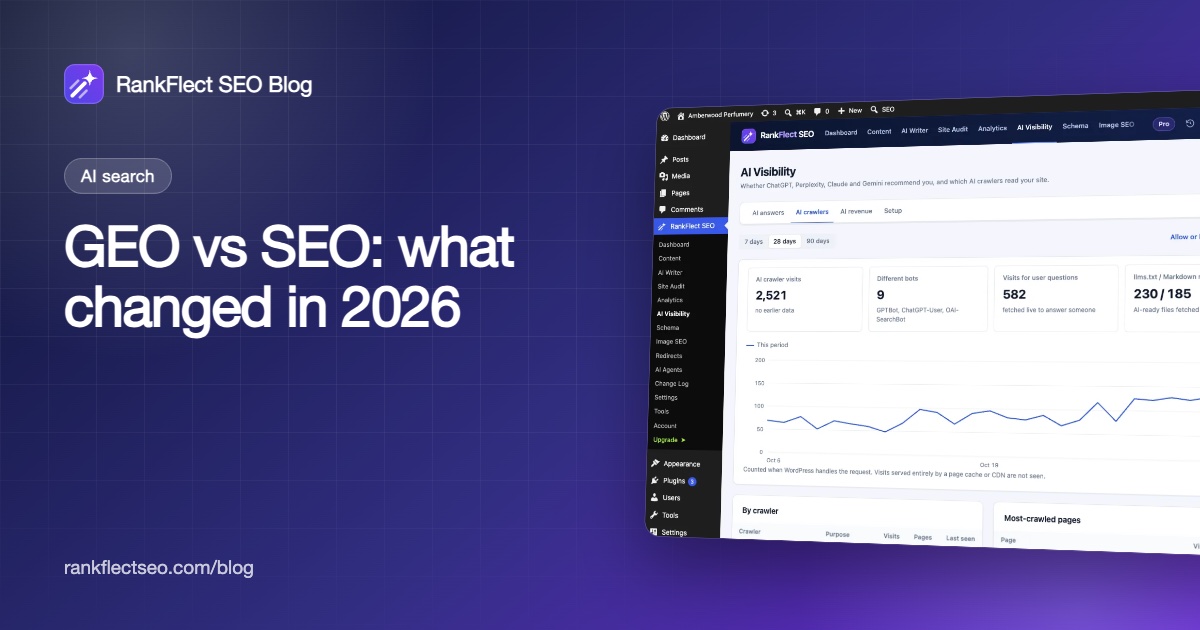
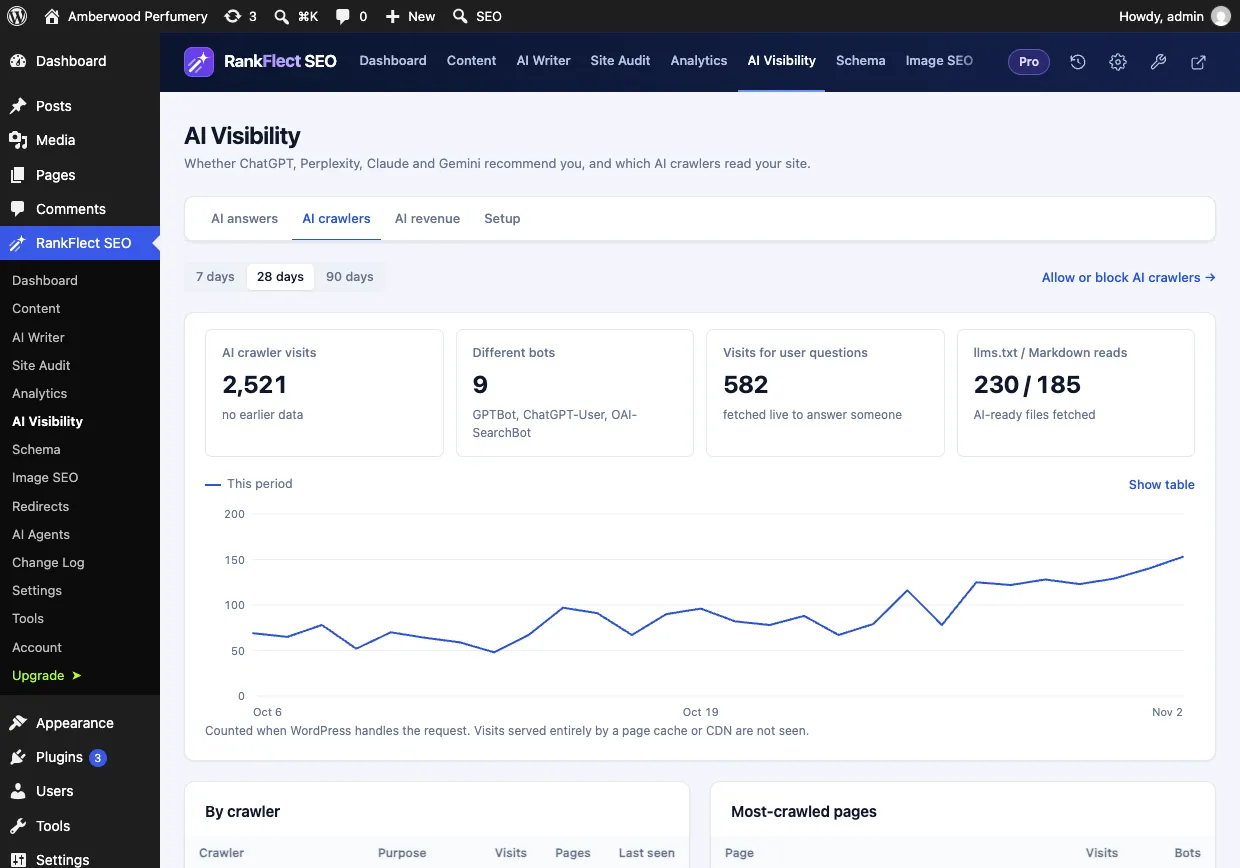
The free AI crawlers tab on the AI Visibility page shows which AI bots visit, how many visits were fetched live to answer someone, and how often AI tools read your llms.txt and Markdown files. See Control and track AI crawlers.
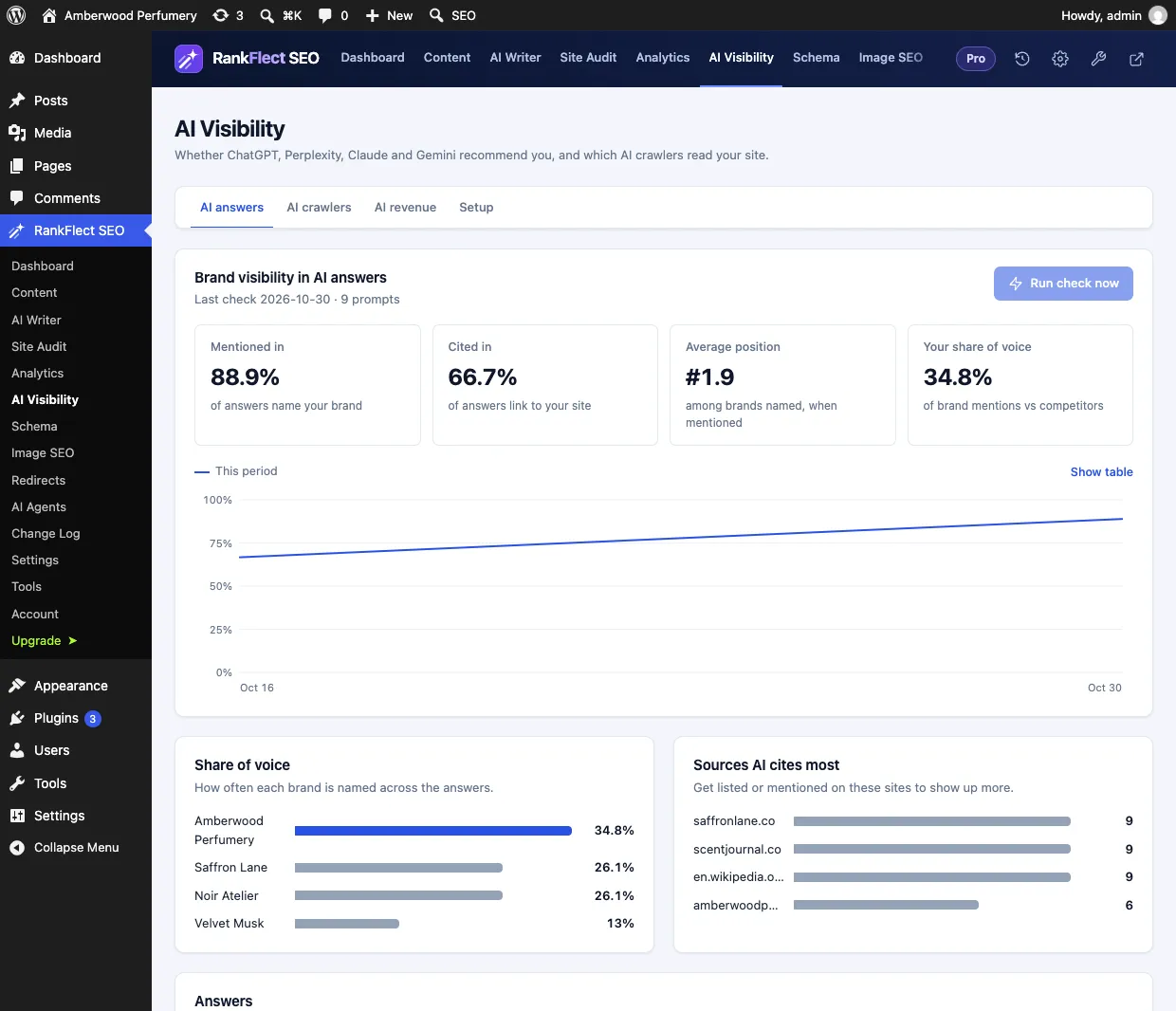
In RankFlect SEO Pro, the AI answers tab asks your configured AI provider your customers' questions with web search on, then records whether the answer mentions you, cites your site, where you are named and your share of voice against competitors. It also lists the sources the assistant cites most. See AI visibility tracking.
The rest of the action list maps to free settings: AI crawler switches in robots.txt settings, llms.txt, Organization or Person identity and IndexNow. The AI search checklist walks through each one. You can download RankFlect SEO free and work through the list on your own site.
Frequently asked questions
Is GEO replacing SEO?
No. AI answer engines still find pages through search indexes and crawlers, so classic SEO remains the foundation. GEO adds crawler decisions, brand mentions and new measurement on top of it.
What is the difference between GEO and AEO?
AEO, answer engine optimization, began as a term for featured snippets and voice answers. GEO comes from a 2023 research paper on generative search engines. In 2026 most people use the two terms for the same goal: being cited in AI answers.
Does GEO hurt my Google rankings?
Not if you do it honestly. Clear structure, specific facts, structured data and fast indexing help classic search too. Hidden text or content shown only to bots can hurt you.
Do I need llms.txt for GEO?
It's optional. llms.txt can help AI tools and agents navigate your site, but Google doesn't use it for Search and adoption by AI assistants is uncertain. Treat it as a low-effort extra, not a priority.
How long does GEO take to show results?
Crawler visits often show up within days. Mentions and citations depend on how well your pages answer the question and how often other sites mention you, so measure over several weeks.
- #geo
- #generative engine optimization
- #aeo
- #ai search
- #wordpress seo
Written by
RankFlect SEO TeamThe people who build RankFlect SEO, the WordPress SEO plugin with a built-in MCP server. We write about what we learn shipping SEO tools for AI search.
All articles →Let AI agents fix your SEO. You keep the undo button.
RankFlect SEO is free for unlimited sites, with a built-in MCP server, approval for every change and no AI credits.