AI Search Statistics 2026: Traffic, Clicks and Citations
Every AI search number here links to its original source: Google, Pew, Similarweb, Cloudflare and Ahrefs, with dates, plus what it means for WordPress.
In this article
- Key takeaways
- A note on how to read these numbers
- AI search usage statistics
- Google AI Overviews and AI Mode
- Chatbots and AI assistants
- Market share among AI platforms
- Clicks and traffic statistics
- AI citation statistics
- AI crawler statistics
- What these AI search statistics mean for WordPress sites
- 1. Being indexed is still the price of entry
- 2. Rankings and traffic have come apart
- 3. Give people a reason to click
- 4. Citations depend on topic
- 5. Measure AI separately
- How to track your own AI search numbers
- Frequently asked questions
- How many people use AI search in 2026?
- Do AI Overviews reduce clicks to websites?
- How much traffic does ChatGPT send to websites?
- Are AI crawlers taking more than they give back?
- Where can I find reliable AI search data?
These AI search statistics for 2026 come only from named, linked sources: Google and Alphabet, Pew Research Center, Similarweb, Cloudflare, Ahrefs and OpenAI's own announcements. Each number shows its source and the month it was published, and anything we couldn't verify against the original was left out. At the end, you'll find what the numbers mean for a WordPress site and what to do about them.
Key takeaways
- AI search is mainstream: Google reports over 2.5 billion monthly AI Overviews users and over 1 billion monthly AI Mode users, and about half of US adults now use AI chatbots.
- Clicks per search are falling where AI summaries appear. Pew and Ahrefs both measured large drops in clicks on classic results.
- AI assistants still send far fewer visits than they crawl, but citations in answers are growing.
- The practical response is the same for every site: stay crawlable and indexed, make pages worth citing and measure AI visibility separately from rankings.
A note on how to read these numbers
Statistics about AI search come from very different methods. Company figures (Google, OpenAI) count their own users. Pew surveys people. Similarweb uses a panel of browsing data. Cloudflare measures traffic across its network. Ahrefs analyzes aggregated Search Console data. Each is useful, but they measure different things, so don't add or compare them directly. Always check the date, too: in this market, a number from 2025 can already be out of date.
AI search usage statistics
Google AI Overviews and AI Mode
- AI Overviews have over 2.5 billion users each month, according to Sundar Pichai in Alphabet's investor presentation (Google, June 2026).
- AI Mode passed 1 billion monthly active users after its global expansion the previous October (Alphabet Q2 2026 earnings remarks, July 2026).
- Google says it is "sending billions of clicks to websites every week through AI features in Search" (same source, July 2026). Google did not give an exact number.
- AI Mode queries are on average three times longer than traditional searches, and one in five AI Mode searches globally use voice, images or documents (Alphabet Q3 2026 earnings remarks, October 2026).
- Google says its year-over-year query growth rate is the highest in five years (same source, October 2026).
Chatbots and AI assistants
- ChatGPT reached 900 million weekly active users and 50 million paying subscribers, as announced by OpenAI and reported by TechCrunch (February 2026).
- The Gemini app has 950 million monthly active users (Alphabet, July 2026). By October 2026, Google described the Gemini app as "now at one billion users" (Alphabet, October 2026).
- 49% of US adults use AI chatbots, up from 33% in 2024, and 24% use them daily (Pew Research Center, published June 2026; survey of 5,119 adults, February 17 to 23, 2026).
- 42% of US adults use chatbots to search for information, the most common use Pew measured (same source).
- 44% of US adults use ChatGPT, 24% Gemini, 17% Copilot and 14% Meta AI (same source). Pew notes its question wording changed in 2026, so compare with earlier years carefully.
Market share among AI platforms
- ChatGPT's share of worldwide generative AI website visits fell from roughly 76% in June 2025 to around 53% in May 2026, while Gemini rose from under 9% to around 27–28% and Claude from barely 2% to close to 9% (Similarweb, July 2026).
- Average monthly web visits to generative AI platforms grew 70% year over year to 9.5 billion, and unique visitors rose 57% to 655 million, for June 2025 to May 2026 (same source).
Clicks and traffic statistics
- Users clicked a traditional search result on 8% of visits to Google results pages with an AI summary, versus 15% without one (Pew Research Center, July 2025; browsing data from 900 US adults in March 2025).
- Users clicked a link inside the AI summary on just 1% of visits to pages that showed one (same source).
- Users ended their browsing session on 26% of visits to pages with an AI summary, versus 16% without (same source).
- 18% of the Google searches in Pew's sample produced an AI summary (same source, March 2025 data).
- The presence of an AI Overview correlated with a 58% lower average click-through rate for the top-ranking page (Ahrefs, February 2026; 300,000 keywords, December 2025 versus December 2023). Position-one CTR on AI Overview keywords fell from 0.073 to 0.016. Ahrefs notes that CTR also fell on keywords without AI Overviews, from 0.076 to 0.039.
- When AI Overviews launched in France, the most exposed domains saw median CTR fall 23.1% in nine days, or 24.8% after adjusting for a control group (Ahrefs, September 2026; 963 of the top French domains, July 2026 launch).
- Google accounts for approximately 88% of referral traffic, according to Cloudflare's network data (Cloudflare, July 2026).
- The share of ChatGPT referrals landing on homepages rose from roughly 26–29% to about 62–63% by late May 2026, after ChatGPT changed how it links to sites (Similarweb, July 2026).
Google offers a different angle on the click question. Its AI features guidance says clicks from search results pages with AI Overviews tend to be higher quality, with users more likely to spend more time on the site. Google has not published numbers for that claim.
AI citation statistics
- The share of US ChatGPT answers with a cited source rose from about 1.6% to roughly 6.8% between June 2025 and May 2026 (Similarweb, July 2026).
- Citation presence varies by industry: about 23% in travel and hospitality and about 20% in automotive, but under 4% in professional services (same source).
- Google launched Search Generative AI performance reports in Search Console, showing how often a site's URLs appear in AI features in Search and Discover. They report impressions, not clicks, and reached all websites worldwide by August 31, 2026 (Google Search Central, June 2026).
Independent, large-scale data on which pages get cited, and why, is still thin. Treat any single "citation factors" study as a hypothesis to test on your own site.
AI crawler statistics
- 52% of crawler requests were for AI training as of June 2026, up from 22% in spring 2025 (Cloudflare, July 2026).
- Mixed-use crawlers, which combine search, agent use and training, account for over 36% of crawler activity (same source).
- More than 50% of internet traffic is now non-human, according to the same Cloudflare report.
- AI bots made an average of 4.2% of HTML requests in 2025, and Googlebot alone made 4.5% (Cloudflare Radar 2025 Year in Review, December 2025; data from January 1 to December 2, 2025).
- Crawl-to-refer ratios in 2025 varied hugely by company: Anthropic reached as much as 500,000 crawls per referred visit, OpenAI peaked at about 3,700:1 in March, Perplexity stayed below 200:1 from September, and Google rose from about 3:1 to a peak of 30:1 in April (same source).
- AI crawlers were the user agents most often fully disallowed in robots.txt files, with GPTBot, ClaudeBot and CCBot named (same source).
What these AI search statistics mean for WordPress sites
The numbers point in one direction: more people ask AI for answers, fewer of them click through on each search, and the visits you do get are spread across more sources. Here is what that means in practice.
1. Being indexed is still the price of entry
AI Overviews, AI Mode and most assistants answer from search indexes and live crawls. Keep your sitemap submitted, avoid accidental noindex tags and let the AI search crawlers in. Training bots are a separate choice; blocking them doesn't remove you from AI search answers. See Control and track AI crawlers.
2. Rankings and traffic have come apart
With fewer clicks per search, a stable ranking can still mean falling traffic. Track conversions per landing page, not only sessions, and watch Search Console's AI impressions alongside your classic performance data.
3. Give people a reason to click
A summary can repeat a fact, but it can't replace a calculator, a downloadable template, current prices, original photos or real experience. Pages with something a summary can't hold are the ones that keep earning visits.
4. Citations depend on topic
Similarweb's industry spread shows that some topics produce cited answers far more often than others. Check what assistants cite for your own customer questions before investing heavily.
5. Measure AI separately
Classic rank tracking won't show AI visibility. Combine AI crawler visits, AI referral sessions in Google Analytics 4 and repeated prompt checks. Our guide to tracking ChatGPT referral traffic in Google Analytics covers the analytics side.
How to track your own AI search numbers
Industry averages tell you the direction. Your own numbers tell you what to fix. RankFlect SEO covers three of the measurements above.
- AI crawler visits (free): the AI crawlers tab on the AI Visibility page shows which AI bots read which pages, split into training, AI search and user requests. See AI crawler tracking.
- AI referral traffic (free): with Google Analytics 4 connected, Analytics → Traffic & AI referrals groups visits from ChatGPT, Perplexity, Claude, Gemini, Copilot and others. See Measure traffic from AI assistants.
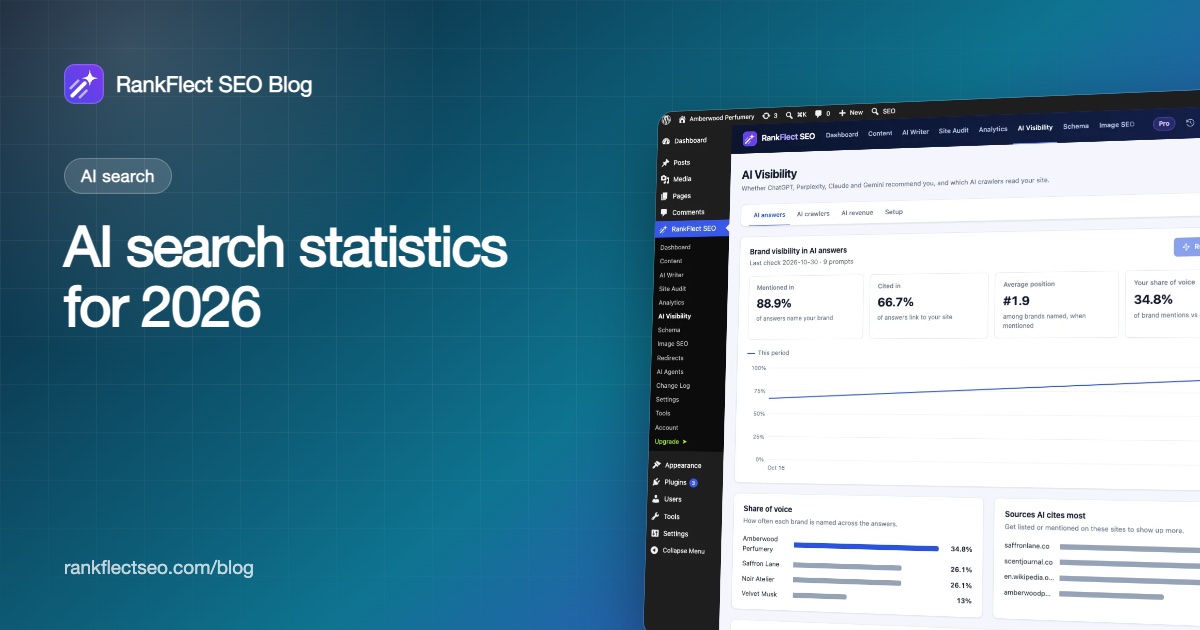
- AI answer visibility (RankFlect SEO Pro): the AI answers tab runs your customer questions through your configured AI provider with web search and records whether you are mentioned, cited, your average position and your share of voice. See AI visibility tracking.
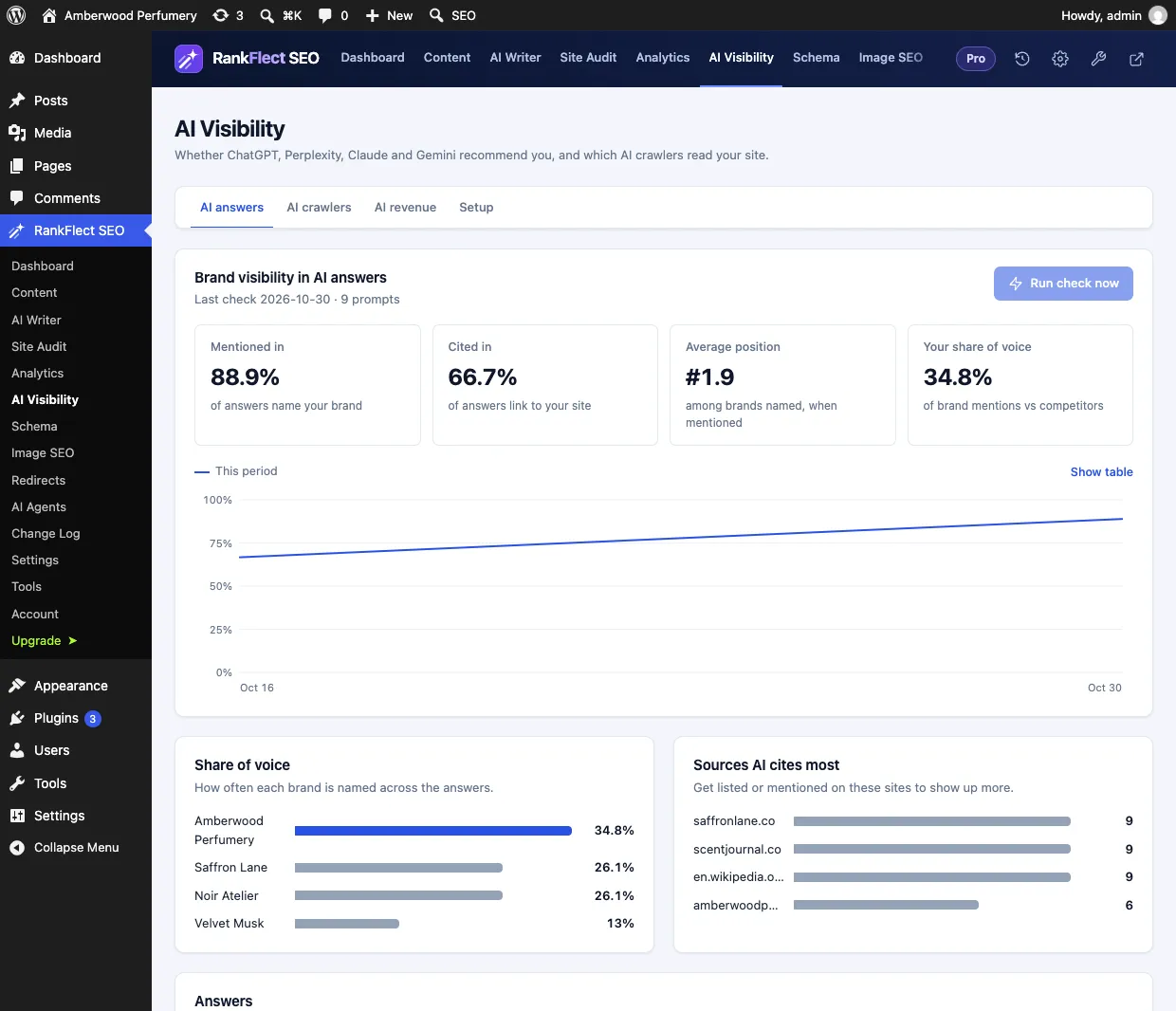
The Sources AI cites most list in that report is often the most actionable part: it shows the third-party sites an assistant trusts for your topic. The AI search checklist explains what to do next. To start with the free tracking, download RankFlect SEO free.
Frequently asked questions
How many people use AI search in 2026?
Google reports over 2.5 billion monthly AI Overviews users and over 1 billion monthly AI Mode users. OpenAI announced 900 million weekly ChatGPT users in February 2026. In the US, Pew found that 49% of adults use AI chatbots.
Do AI Overviews reduce clicks to websites?
Studies say yes for classic results. Pew measured clicks on 8% of visits to pages with an AI summary versus 15% without, and Ahrefs found a 58% lower CTR for the top result when an AI Overview appears. Google says the clicks that remain tend to be higher quality.
How much traffic does ChatGPT send to websites?
It depends heavily on the site and topic, and public totals vary by method. Similarweb found that the share of US ChatGPT answers with a cited source rose to roughly 6.8% by May 2026. Check your own Google Analytics 4 data for chatgpt.com sessions to see your number.
Are AI crawlers taking more than they give back?
By Cloudflare's 2025 data, AI companies crawled far more pages per referred visit than Google did, with ratios ranging from hundreds to hundreds of thousands to one. Whether that trade is worth it is a business decision; you can allow AI search bots and block training bots separately.
Where can I find reliable AI search data?
Start with primary sources: Google Search Central and Alphabet's earnings remarks, Pew Research Center, Cloudflare's blog and Radar, Similarweb's research and the original studies from SEO tool vendors. Always check the date and the method before you quote a number.
- #ai search statistics
- #ai overviews
- #chatgpt
- #ai crawlers
- #zero-click search
Written by
RankFlect SEO TeamThe people who build RankFlect SEO, the WordPress SEO plugin with a built-in MCP server. We write about what we learn shipping SEO tools for AI search.
All articles →Let AI agents fix your SEO. You keep the undo button.
RankFlect SEO is free for unlimited sites, with a built-in MCP server, approval for every change and no AI credits.